
August 5, 2026 /
Every so often, a scan reveals something unrelated to your MS, such as a small cyst, a benign lump, a blood vessel variation, or a bit of inflammation in your sinuses.
Gavin Giovannoni – Jul, 2026

What is an incidentaloma?
If you live with multiple sclerosis (MS), you will have many MRI scans over your lifetime; first to help make the diagnosis, and then at regular intervals to monitor your disease and check how well your treatment is working. MRI is a remarkably detailed way to look at the brain and spinal cord, and it is very good at detecting abnormalities.
Sometimes it picks up too much. Every so often, a scan reveals something unrelated to your MS, such as a small cyst, a benign lump, a blood vessel variation, or a bit of inflammation in your sinuses. Because these findings are discovered by chance rather than sought, doctors call them incidental findings, or, more informally, incidentalomas. The name simply means “a thing found incidentally”; it does not imply anything about its seriousness.
Incidentalomas are not unique to MS. They turn up whenever people have brain scans, whatever the reason. But people with MS are scanned far more often than the general population, which means they have more opportunities for one of these chance findings to appear.
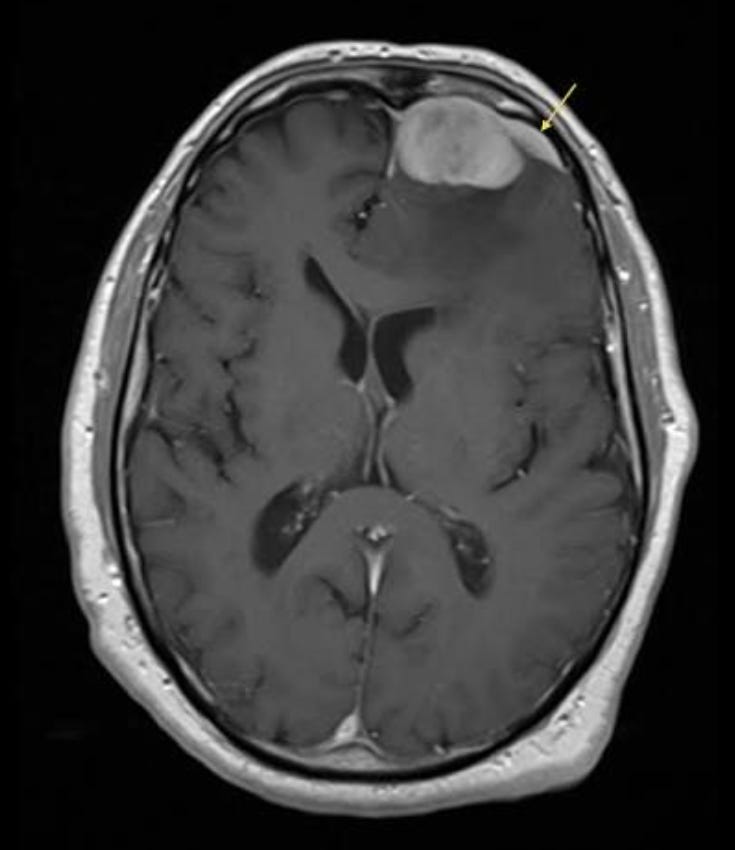
How common are they?
More common than most people expect, but they are usually harmless.
In the general adult population, large-scale studies provide a good baseline. According to research retrieved from PubMed and the wider literature, the population-based Rotterdam Scan Study found that roughly 1 in 10 adults has some incidental finding on a brain MRI, a figure that rises with age. The most frequent findings were silent (symptom-free) small strokes in about 7% of older adults, small brain aneurysms in about 1.8%, and benign tumours — mostly meningiomas — in about 1.6% (Please see paper 1 below).
In younger, healthy adults, the picture is reassuring. According to a large French student imaging study, only about 4% of people aged 18–35 had any incidental finding, and fewer than 2% had one that needed a referral to a specialist.
What about people who already have MS? A Canadian study that specifically looked at this question found incidental abnormalities in about 15% of people with MS, a rate no higher than in the matched comparison group without MS. The authors concluded that although MS itself does not create extra incidental findings, the sheer number of scans people with MS undergo means a sensible plan for handling these findings is essential (Paper 2 below).
The key message from these studies is that incidental findings are common, but serious ones are rare.
The spectrum of incidentalomas
Incidentalomas fall into a few broad groups. The table below summarises the most common types, roughly how often they occur, and what usually happens next. The percentages are drawn from general-population studies and will vary with age and scan quality.
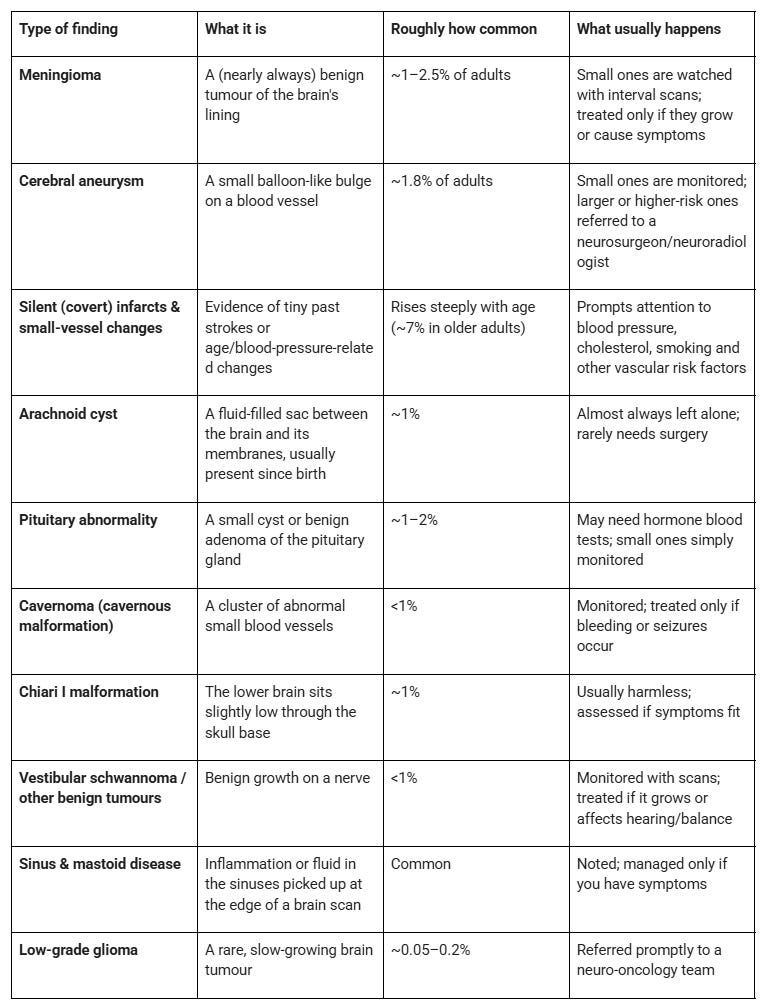
Most items on this list are benign, slow, or static. The purpose of listing them is not to alarm but to show that the vast majority sit in the “watch and reassure” category rather than the “urgent action” category.
A special case: findings that look like MS in people who don’t have symptoms
CLICK HERE, to continue reading

Stay informed with MS news and information - Sign-up here
For MS patients, caregivers or clinicians, Care to chat about MS? Join Our online COMMUNITY CHAT